

Investing in Startups: How Does It Work? A Complete Guide
Put simply, a startup is a company at an early stage of its development. The term usually refers to a business that offers a new technology not yet available on the market, or a fresh approach to solving problems in existing industries.
Because the idea itself is new and the business usually has no resources other than the idea and its staff, it is hard for the entrepreneur, the startup's founder, to raise money to grow the business. That is why funding is usually sought through non-traditional means: instead of bank loans, founders attract investment from business angels and venture funds, or turn to crowdfunding and other instruments where investors are willing to back a company with high risks but equally high potential rewards.
Today we look at the ins and outs of investing in startups, from the perspective of both investors and the startup itself.
Contents:
- What are the investment terms at different stages (rounds)
- What are the ways to raise investment? How it works in Kazakhstan
- How a startup can assess whether it needs investment at its next stage of development
- How a startup can prepare to raise investment
- How to calculate the amount of investment for a startup
- Five startups that found their investor – Activat VC
- What metrics are used to evaluate startups
What are the investment terms at different stages (rounds)?
Startups need funding at every stage of their life: from the very beginning, when there is only an idea, to the point where they have their first products that potential customers can already use. Developing apps, services or product samples requires significant financial resources (at the very least, to pay the staff) and time to test hypotheses and build prototypes.
That is why investment is raised at every stage. But the terms can vary greatly depending on the stage. Below is a brief description of each one.
Pre-Seed and Seed investment. At this stage, the amounts invested are usually small, from a few thousand to a few hundred thousand dollars, and in return investors receive a significant stake in the company: 10-30% or even more.
The company's valuation at this stage can be quite low, because the business has not yet proven its concept and has no significant revenue. Or no revenue at all yet.
Round A (or Series A) investment. Here investment grows to a range of several hundred thousand to several million dollars. But investors receive a smaller stake than in previous rounds, around 15-25%. This is because the company has already grown significantly thanks to the support of its first investors, has been able to prove its concept and is generating its first revenue.
Round B (or Series B) investment. Here the investment ranges from several million to tens of millions of dollars, in exchange for which investors can receive a stake of 10% to 20%. At this stage, startups (those that have “survived” this long) already command a high valuation, as they demonstrate growth and the scalability of their business.
Round C (or Series C) investment and subsequent rounds. At this stage, investment is measured in tens of millions of dollars, while investors receive less than a 10% stake in the startup. Companies here already have steadily growing revenue, are scaling and are strengthening their market position.
The above are the main terms regarding investment amounts and the stakes investors receive; in each case they will be unique. But there are other terms as well, such as the investor's voting rights, the degree of their involvement in managing the startup, and exit terms.
Experts note that before signing an investment agreement, it is important to hold detailed negotiations and spell out all the fine points and contentious issues to avoid any “blank spots” in the relationship between the investor and the startup team.
What are the ways to raise investment? How does it work in Kazakhstan?
Without investment, a startup simply cannot grow. Even if the team has its own initial capital, it may run out before the company releases a product or starts making its first profit. That is why founders work on raising investment, and there are plenty of instruments for this, including in Kazakhstan.
Business angels. These are private individuals, usually successful entrepreneurs or businesspeople, who are willing to invest their own money in promising startups. You can attract them by attending networking events, showcasing your product at startup pitches or using platforms that connect you with investors.
For example, last year Astana Venture Club, a community of business angels interested in investing in and supporting promising tech entrepreneurs, was launched in Astana. There is also the Activat Invest club, which brings together investors ready to invest in startups.
Venture funds and companies. These are specialized organizations that invest capital from institutional and private investors in young companies with high growth potential. You can meet them and get them interested in your product by directly presenting a detailed business plan that is attractive for investment, or by taking part in events attended by venture capitalists.
For example, Activat VC has been operating in Kazakhstan since 2014, investing in early-stage startups. As the company's own website states, it invests money, expertise and established partnerships to support startups and help them scale their business.
Crowdfunding. This means raising investment through online platforms where small investors offer their funds, often without expecting anything back or in exchange for free access to the startup's product.
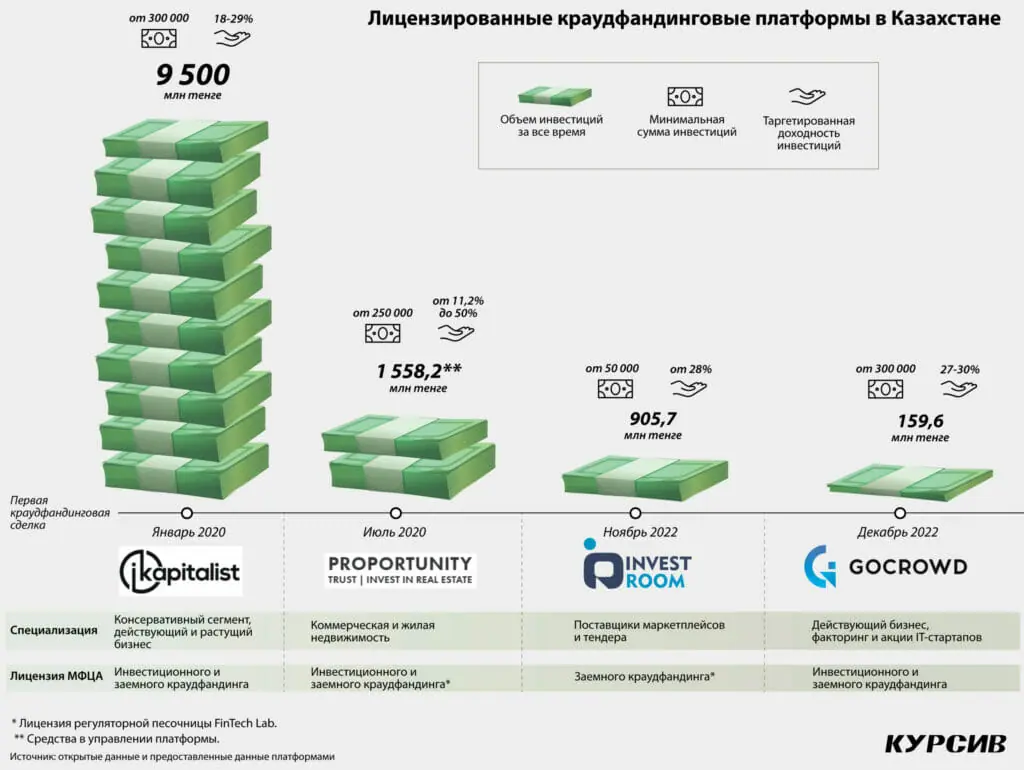
Kazakhstan's Kursiv.media reports that there are four licensed crowdfunding platforms in the country: iKapitalist, Proportunity, InvestRoom and GoCrowd. “Since 2020, about 200 projects with a total value of more than 12 billion tenge have been implemented through such platforms,” the authors of the article write.
Corporate investment. Some large companies may invest in startups that help solve problems in their industry or improve business efficiency. Such cooperation can be established by searching for partners directly and emphasizing the technological or innovative value for the corporation.
Government and private grants. There are government bodies and non-profit organizations that award grants to support innovation and startups. To get such a grant, it is important to look out for relevant events and competitions.
For example, in Kazakhstan government grants are awarded by the National Agency for Innovation Development “QazInnovations”. Support is provided in the areas of technology commercialization and sectoral development.
Accelerators. These are organizations that can provide both financial resources (accelerators are usually owned by venture companies or have cooperation agreements with them) and non-financial support, such as free office space, mentoring, and participation in training and educational programs.
For example, Astana is home to the Astana Hub tech park, which offers tax incentives and the infrastructure a startup needs to grow. It also regularly hosts master classes.
You can read more about each of these instruments in an article by Kazakhstan's Informburo.kz, which gives examples of crowdfunding platforms in Kazakhstan and describes in general how everything works in our country.
“Startups need the right conditions to grow: an ecosystem of incubators and accelerators, and the finance itself, meaning crowdfunding platforms, venture funds, government grants and private entrepreneurs willing to invest in ideas,” the journalists write.
Startup teams usually don't limit themselves to a single fundraising instrument. For example, you can receive a grant for your idea and attract funding from a business angel at the same time. The key is to keep a balance of interests among all parties.
How can a startup assess whether it needs investment at its next stage of development?
It all depends on whether the startup really needs new investment rounds to grow. For example, bringing in venture capitalists or business angels will provide additional resources, but it will also mean giving up a stake in the business and, as a result, additional oversight of the team's work. To assess the need for investment, you need to take several steps.
- Financial assessment. Analyze your current financial performance, including revenue, costs, net profit and cash flow. You may be able to cover operating and other expenses with the funds you already have.
- Assessing capital needs. Here you need to determine what resources and investment are required to achieve the startup's current strategic goals. If they cannot be achieved without additional funds, it is worth considering looking for investors.
- Risk assessment. It is important to analyze the risks and challenges the startup faces and decide whether they can be overcome without additional investment.
- Assessing business readiness. Assess the company's readiness for investment as objectively as possible. This includes having a well-developed business plan, hypotheses and well-grounded forecasts that can attract the attention of potential investors.
- Developing a plan for using the investment. You should have a well-developed plan for what the startup will spend the investment on and how. This is important so that the money is not wasted and actually benefits the business.
Overall, before deciding to raise investment, a startup should carefully weigh all the pros and cons so as not to end up in a disadvantageous position after the next investment round. Money is good, but it also brings new obligations.
How can a startup prepare to raise investment?
Preparing for the next investment round is an important stage in a startup's development. To succeed, you need to prepare well. Below are several steps worth taking.
- Developing a business plan. A startup should have a detailed business plan that includes a description of the business, target audiences, competitor analysis, marketing strategy, financial forecasts and a plan for using the funds.
- Determining funding needs. Determine the exact amounts the startup needs, with clear reasoning for what they will be spent on and why it matters. This will help investors understand exactly how their investment will be used.
- Financial transparency. It is important to prepare financial statements, including a profit and loss statement, a balance sheet and a cash flow statement. You should demonstrate financial transparency and an understanding of your metrics.
- Showcasing achievements and demonstrating the product. Prepare a presentation or an investment memorandum that clearly describes what the company has already achieved and what goals it plans to reach. And if possible, demonstrate the startup's product to investors right away. This will increase investors' confidence in the startup's viability.
- A strong team. Hiring is crucial for a startup in the early stages of its development, because the team is often the only strength and the only capital the business has.
- Finding mentors. Bring in mentors, experienced entrepreneurs and investors to get advice and feedback on the startup's development. They can provide valuable recommendations and help with preparation.
- Legal readiness. In addition to financial transparency, legal transparency matters too. It is important to have an officially registered legal entity; otherwise investors will not be able to sign investment agreements with you.
How to calculate the amount of investment for a startup?
This question is fairly simple. The main purpose of investment is to support the startup's growth and development, so the amount should meet this need.
That is why you first need to determine the needs of the startup and its team. These may include various aspects, such as product development costs, scaling marketing, increasing production capacity, expanding the team and so on.
The next step is developing a business plan. It is important to set out detailed financial forecasts and estimate the major expenses and income expected over a certain period of time. You should also include a “safety cushion” for unexpected expenses or for adapting to market changes.
Another important point is assessing investment risk. This includes possible market changes, competition, technological challenges and so on. It is important to analyze them in order to anticipate possible expenses caused by potential problems. This will also show investors how promising it is to invest in the startup.
Five startups that found their investor – Activat VC
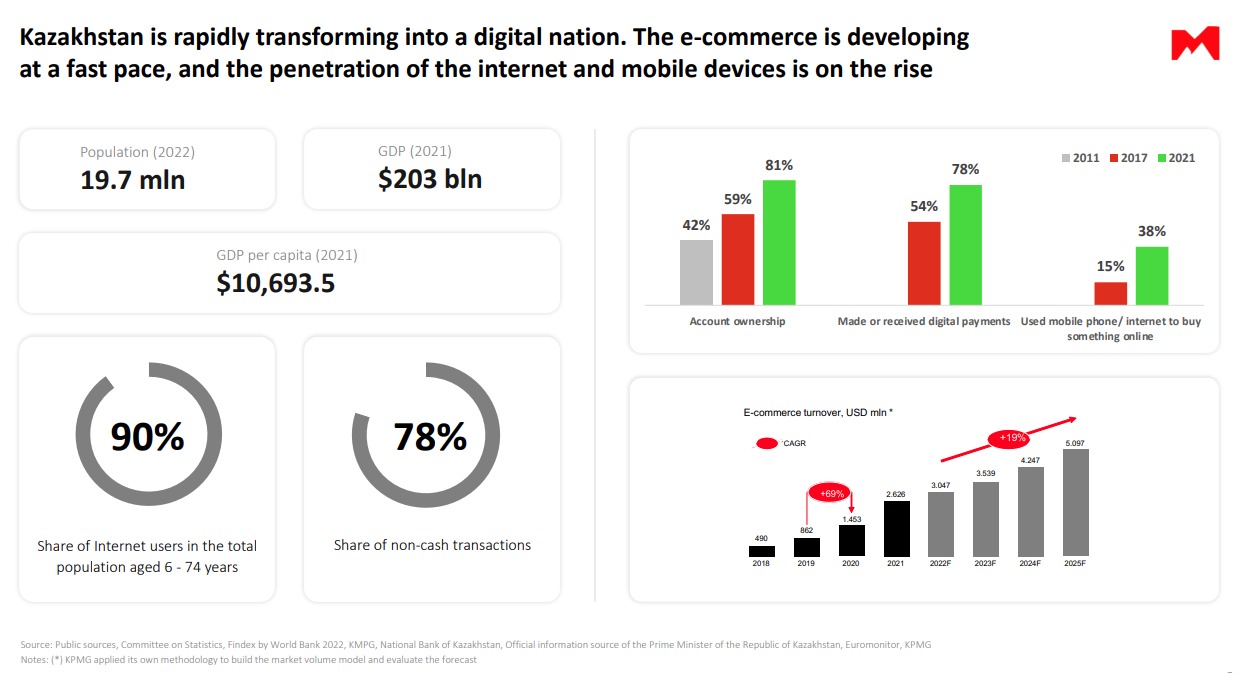
In recent years, Kazakhstan's venture market has been developing actively, creating more and more opportunities for startups to raise investment within the country. For example, a Kazakhstani study “Venture Capital Market Overview in Kazakhstan” states that the total volume of deals in the country's venture market from 2018 to 2022 was approximately $87 million. This figure includes only public deals, but in practice the market volume may exceed $140 million. The study also notes that in 2018-2022 business angels provided 45% of all venture investment, and venture funds 8%. The rest came from incubators and accelerators, as well as corporate investment and investment clubs.
One of the players in this market is the venture company Activat VC, which has been investing in promising companies since 2014. Its portfolio includes more than 20 cases, and these companies operate successfully in Kazakhstan and abroad.
The first example. I-teka is a Kazakhstani digital service that connects patients with healthcare providers: medical centers, doctors and pharmacies. The company's website lets you check whether particular medicines are available in cities across Kazakhstan, which was a real breakthrough in this field at the time of launch. The company is currently owned by Activat VC itself.
“Activat VC gave us tremendous support in developing our company. We received invaluable advice that helped us find our bearings in the market and define our priority goals and development strategy. We also received help with financing,” says Zhuldyzai Seidalina, CEO of I-teka.
The second example. EasyTap is a service for finding hourly workers for stores and restaurants. The company was the first in this niche in Kazakhstan and now plans to expand into other Central Asian markets. EasyTap's founders received investment from Activat VC, which allowed the company to grow and bring its product to the commercial market.
The third example. Billz is a retail management platform for small and medium-sized businesses that includes tools for managing points of sale and inventory, CRM, analytics, e-commerce and financial tools.
“Partnering with Activat VC was a key milestone on our path to scaling in Kazakhstan. Thanks to their support and fast decision-making, we were able to close a funding round in record time and gain momentum for growth in the Kazakhstan market,” says Rustam Khamdamov, CEO of Billz.
The fourth example. ApartX is a service for renting out apartments and managing them with smart locks. The company received investment from Activat VC. Kanat Keldibekov, CEO of ApartX, notes that the venture company's team takes a close look at projects and gives “good feedback based on its experience.”
The fifth example. QazTracker is a system that allows real-time monitoring of animal health.
“Activat VC was the first venture investor to believe in our project. Special thanks to Marat Tolibayev and the entire Activat team for their financial support and mentorship,” says Dinar Benseitov, CEO of QazTracker.
All of these companies operate successfully in the market and offer people and businesses new opportunities to grow and increase their income.
What metrics are used to evaluate startups?
Startup valuation is a complex financial process, but a number of different metrics help with it. Below are some of the most important ones.
Revenue. This is the total amount of money a startup earns from selling its goods or services. This metric is especially important for startups focused on monetization.
Monthly Active Users (MAU). This is the number of unique users who interact with the startup's product or service over a month. This metric can indicate how popular the product is.
Customer Acquisition Cost (CAC). This is the total cost of acquiring new customers divided by the number of new customers. A low CAC is usually considered a positive sign.
Lifetime Value (LTV). The projected total profit a startup can expect from a single customer over the entire relationship. LTV should be higher than CAC for the business to be considered sustainable.
Total Addressable Market (TAM). This metric refers to the size of the market the startup can potentially serve. Investors may be interested in startups with a large TAM, as it points to significant growth potential.
Net Profit. This is the difference between revenue and total costs, and it is generally a key indicator of a startup's financial sustainability.
Growth Metrics. These include monthly or annual percentage growth in revenue, number of users, conversion and other indicators that reflect the business's growth dynamics.
It is best to use these metrics together to assess a startup's value, sustainability and prospects more accurately. This is key when investing, in order to reduce the risk of losses as much as possible.


