

What Mistakes Do People Make When Launching a Startup?
Films and the media usually show only successful startups. It is these startups that motivate millions of people around the world to launch their own projects and turn them into “unicorns.” But does everyone succeed? Open statistics show that about 90% of new companies fail: 10% within the first year of operation and another 70% within 2-5 years.
The main reasons startups fail are a lack of market need for the product (42%), problems with financial management (29%), a poorly assembled team (23%), pricing issues (18%) and a service that is inconvenient for customers (17%).
But all of these mistakes can be avoided. To become the next Google or Amazon, you need to assess your startup's weak points in advance and address them. Here is how to do it.
The most common mistakes
Most future problems are built in at the very start of a startup's journey. They may “backfire” right away or later on, but the key point is that they are everywhere. And even if you have solid funding or a team of professionals, you will not be able to avoid collapse. Below are some of the main failure factors that startups face.
Choosing the wrong idea. The wrong startup idea can leave you without customers in the market. You may need to reconsider the idea or reshape it so that it solves customers' real problems rather than imagined ones.
Misjudging the market. A poor understanding of the target audience and market trends can lead to failures in customer acquisition. If you try to sell to people who do not need the product, you will not be able to make a profit.
Insufficient competitor analysis. A superficial study of competitors can leave a business vulnerable to changes in the industry. Keep an eye on what your competitors are doing and how they are developing their products.
No business plan. A business plan gives you a clear action plan, strategy and financial forecasts. It is often poor money management that deprives a startup of any prospects for survival and growth.
The wrong team. Building the right team is essential for managing and growing a business effectively. You need to hire specialists whose knowledge and skills will help develop the product.
Insufficient funding. A shortage of funds can leave a business vulnerable to unexpected financial difficulties. That is why you should be more active in attracting investors, so that the company has money for its operations and for unforeseen expenses.
The wrong marketing. A marketing strategy that does not match audience expectations can lead to failures in promoting a product or service. You may simply “miss” your audience or create an unappealing image of the product.
Not being ready to scale. If a business is not ready to expand, this can cause problems down the road. It is often scaling that brings in new revenue and attracts new investors.
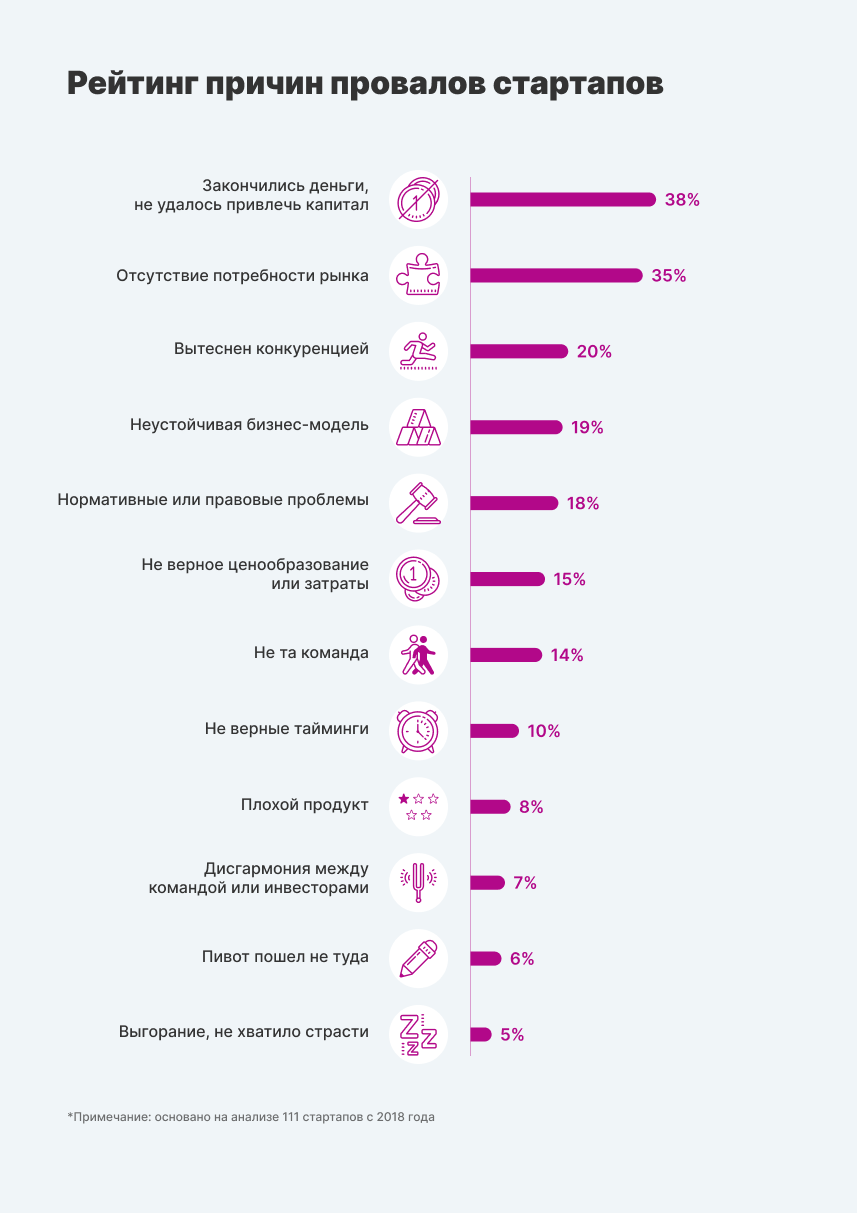
If you manage to take all of these factors into account when launching a startup and keep monitoring them, the startup's chances of success will increase significantly.
How can you avoid mistakes when launching a startup?
The action plan here is simple: build on the experience of startups that have failed. After all, a startup is first and foremost a risky venture.
- Research the market thoroughly. Conduct research to understand the demand for your product or service, study the competition and define your target audience.
- Develop a clear business idea. It is important to define a clear startup idea that solves a specific problem or meets a specific customer need.
- Draw up a detailed business plan that includes a marketing strategy, financial forecasts, a competitor analysis and plans for future scaling.
- Test the startup concept. Before a full launch, test the concept, get feedback from potential customers and make the necessary changes to the idea.
- Assemble a strong team. It should be made up of qualified and motivated specialists who can bring the startup idea to life.
- Raise funding. It is important to develop a funding strategy to secure enough resources to grow and scale the startup.
- Monitor and manage risks. Identify potential risks and develop a strategy to reduce their impact on the business. Be prepared to adapt quickly when necessary.
- Focus on promotion and marketing. The specialists on your team will help you develop a marketing strategy to promote the product or service. Do not forget about brand building either, as it also helps drive sales.
- Always talk to your customers. Customer feedback will help you improve the product.
- Be flexible and adapt. A startup team must always be ready for changes in market conditions and respond quickly to shifting circumstances.
It is important to remember that running a startup is a continuous process of change, and a willingness to learn from mistakes and constant improvement can be the key to success. Or, at the very least, they will help you avoid many of the problems that caused your predecessors to fail.


